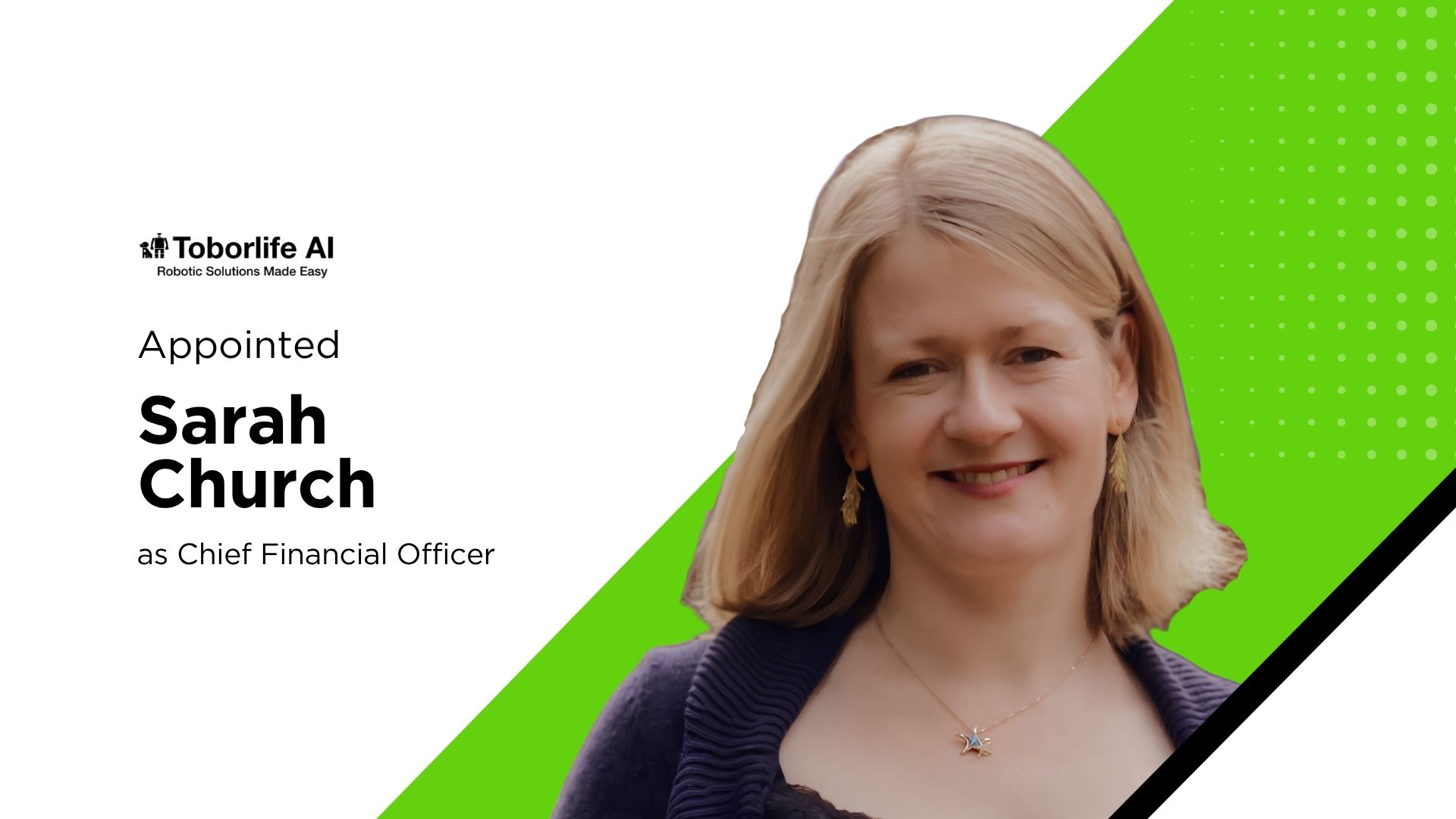
Toborlife AI names new CFO amid robotics expansion. The San Francisco‑based robotics firm announced the appointment of Sarah Church as chief financial officer, a move aimed at scaling its enterprise‑grade robot distribution and software platform across North America.
Toborlife AI, the developer of the Tobor Harness™ suite and official partner of Unitree Robotics, revealed that Sarah Church will take the finance helm as the company accelerates its go‑to‑market strategy for industrial‑grade robots.
Why the CFO hire matters
Church arrives with a résumé that straddles deep‑tech finance and large‑scale operations. Her most recent role was senior finance leader at Taara, an Alphabet X spin‑out focused on optical‑connectivity infrastructure. Prior stints at Instrumental Inc., Google, and Barclays gave her exposure to capital‑intensive hardware programmes and rapid product cycles. “Sarah’s career path has given her a unique specialty at the intersection of where physical hardware, working capital, and rapid engineering iteration all have to work together,” said David Schulhof, founder and CEO of Toborlife AI.
The CFO’s mandate goes beyond bookkeeping. In her first 90 days, Church will map out investment priorities, tighten reporting cadence, and install real‑time dashboards for the board. Over the next year, she will partner with Schulhof to negotiate commercial and investor deals while safeguarding liquidity as Toborlife expands its product line, enters new geographies, and adds use cases such as autonomous inspection and outdoor material handling.
Toborlife AI’s hardware‑software stack
Industry data underscores the timing. Gartner predicts that global industrial robot shipments will grow at a 30 % compound annual growth rate through 2028, driven by demand for flexible automation in “lights‑out” factories. IDC estimates that the market for robot‑as‑a‑service platforms will exceed $12 billion by 2027, with software integration cited as the primary barrier to adoption. By coupling off‑the‑shelf hardware with a proprietary control layer, Toborlife is tackling the software gap that Gartner identifies as a choke point for mid‑market enterprises.
Competitors such as Boston Dynamics and Agility Robotics have focused on high‑performance, specialty robots that require extensive engineering support. Toborlife’s model is more akin to the “robot‑in‑a‑box” approach championed by Amazon’s Astro and Microsoft’s Azure IoT Edge, where the value proposition rests on ease of deployment and API‑first integration. The company’s partnership with Unitree gives it a cost advantage—Unitree’s G1 units retail for roughly $12,000, a fraction of the $75,000 price tag of comparable Boston Dynamics platforms.
Competitive landscape in enterprise robotics
For enterprise marketing teams, the development signals a new channel for client engagement. Robots equipped with Tobor Harness™ can collect operational data—cycle times, load metrics, environmental conditions—and feed it into CRM or analytics stacks such as Salesforce or Adobe Experience Cloud. Marketers can then craft performance‑based service offers, upsell predictive maintenance contracts, or showcase ROI dashboards to prospects. The integration potential aligns with the broader trend of embedded finance, where hardware becomes a conduit for subscription‑based revenue streams.
Implications for enterprise marketing
Looking ahead, Church’s financial stewardship will be measured by Toborlife’s ability to translate technical capability into recurring revenue. The firm has already secured pilot contracts with a major U.S. retailer and a construction conglomerate, but scaling those pilots into multi‑year agreements will require disciplined capital allocation and transparent metrics—areas where Church’s experience at Alphabet X and Taara could prove decisive.
In sum, the CFO appointment is less a PR splash than a strategic inflection point. By reinforcing its finance function with deep‑tech expertise, Toborlife AI positions itself to capture a slice of the rapidly expanding industrial robotics market, while offering enterprises a more accessible, software‑centric automation layer. The move also illustrates how finance leaders are becoming critical architects of product strategy in hardware‑intensive startups, a shift that investors and competitors alike will watch closely.
Market Landscape
The industrial robotics sector is entering a growth phase fueled by AI‑driven perception and low‑cost actuators. Gartner’s 2025 forecast projects a 30 % CAGR for robot shipments, while Forrester notes that 45 % of midsize manufacturers plan to add autonomous mobile robots (AMRs) by 2026. Capital efficiency is emerging as a decisive factor; firms that can bundle hardware with a scalable software platform are attracting both venture capital and enterprise contracts. Toborlife AI’s strategy of pairing Unitree’s affordable G1 chassis with a proprietary teleoperation layer mirrors the “software‑first” paradigm that has propelled cloud providers to market dominance.
Top Insights
- Sarah Church’s deep‑tech finance background aligns with Toborlife’s need for disciplined capital deployment as it scales robot distribution.
- The Tobor Harness™ platform bridges the gap between low‑cost hardware and enterprise‑grade software, a key differentiator from high‑price competitors.
- Gartner predicts a 30 % CAGR in industrial robot shipments through 2028, underscoring the market tailwinds behind Toborlife’s expansion.
- Enterprise marketers can leverage robot‑generated data to enrich CRM systems, create performance‑based offers, and unlock new subscription revenue streams.
- Toborlife’s partnership with Unitree gives it a cost advantage, positioning the firm to win price‑sensitive contracts in logistics and construction.
Get in touch with our fintech expert