1. Your career has been built around financial partnerships. What does a decade of building partnerships with banks and financial institutions teach you about where fintech value gets created versus where it gets announced?
Signing a partnership is already hard. You go through rigorous onboarding, compliance and risk reviews, commercial negotiations, contracting and scrutiny of the business model. But in many ways, the harder work starts once you go live.
As the business scales and evolves, you have to maintain compliance, adapt the partnership to new opportunities and keep building trust on both sides. The strongest partnerships I’ve seen are those where both parties are willing to work through challenges together, rather than defaulting to “no” when something gets difficult. That is where the real value gets created.
2. You were elected President of SFA in March 2025. You stepped into the role at a specific moment. AI is reshaping financial services, cross-border payment infrastructure is being rebuilt, and the regulatory environment is moving faster. What is the strategic priority you set for SFA from day one?
My priority was to make sure SFA keeps pace with where the industry is going and stays genuinely relevant to our members. That starts with deep engagement, understanding the real challenges companies are facing rather than assuming we know what they need.
It also means representing the smaller players, founders and aspiring founders, not just the largest companies with the loudest voices. Talent is another big priority, particularly creating pathways for young people into fintech.
And regionally, I want SFA to build stronger connectivity at the association and grassroots level. Our members are already operating across the region. We can complement that by connecting fintech communities, associations and founders across markets, giving our members more direct access to local ecosystems and a stronger collective voice in the region.
3. Singapore’s fintech ecosystem is sophisticated relative to most markets. What is SFA’s specific role in helping Singapore-based fintechs navigate that regional complexity and where does the industry body’s influence stop?
A big part of our role is opening doors. Through our mission trips and relationships with fintech associations and ecosystems across the region, we can bring companies into markets as a group. I see real is value in that. It is very different from ten companies each trying to knock on the same doors individually.
We can make the introductions, help them understand the local landscape and connect them with regulators, partners and other fintechs. But ultimately, every company has to navigate its own regulatory requirements, compliance and localisation.
4. AI in financial services creates a specific accountability problem. How should financial institutions be thinking about that accountability gap, and what does responsible AI deployment look like in practice rather than in a policy document?
For me, responsible AI starts with being clear about who remains accountable when AI is making or influencing decisions. At SFA, we have been looking at this quite practically. Our recent report with one of our members, Sumsub, explored how trust, identity and accountability need to evolve as AI becomes more autonomous. We have also been engaging the industry around frameworks such as SAFR, which looks at how financial institutions can assess and manage the risks of agentic AI.
We stay closely engaged with MAS as these issues develop. Regulation and governance frameworks are important, but they need to keep pace with how companies are actually deploying AI. SFA’s role is to bring those real industry experiences into the conversation.
5. Cross-border payments infrastructure is being built at the government and central bank level, but the commercial layer is being built by fintechs competing for the same opportunity. How do those two layers stay aligned and what happens when the infrastructure moves faster than the commercial ecosystem can absorb it?
I would actually challenge the idea that these are two separate layers. Singapore’s experience with FAST and PayNow shows that infrastructure works best when the public and private sectors build the ecosystem together.
Fintechs and non-bank financial institutions have been closely involved, including gaining direct access to FAST. There has also been continuous engagement between MAS, financial institutions, fintechs and industry bodies like SFA. That gives the industry a seat at the table as the infrastructure evolves.
So for me, it is not so much about slowing infrastructure down until the commercial ecosystem catches up, but involving the commercial ecosystem early enough that infrastructure and adoption evolve together.
6. TechWeek Singapore brings together technology leaders, government stakeholders, and the investor community. From your position leading SFA, what is the conversation about technology and financial services ecosystem that you think needs to happen at this event?
I think we need to talk more about the demand side of innovation. Singapore has invested significantly in the supply side, from funding and regulatory support to talent and infrastructure. But innovation only scales when someone is willing to be the customer.
For fintechs, that first major institutional reference client can be transformational. We should think about how banks, large corporates and the public sector can create more pathways for credible fintechs to win those first customers and prove themselves here. A strong ecosystem needs both sides. We need to support companies to build, but also create the conditions for good solutions to be adopted.
7. Technology leaders attending TechWeek are making decisions about infrastructure, partnerships, and market expansion across Southeast Asia. What is the one thing you want them to understand about the fintech infrastructure landscape?
The ecosystem matters enormously. Singapore is a strong regional hub because you have regulators, financial institutions, fintechs, investors and talent, and ecosystem partners like SFA, operating in close proximity. That creates a good base from which to build across Southeast Asia.
But being regional does not mean one model works everywhere. Southeast Asia is a large, diverse, and highly fragmented market, each with its own regulatory framework, payment infrastructure and customer needs. Companies still need deep localisation and strong local partnerships. The opportunity is regional, but success is ultimately built market by market.
8. If you could put one specific industry commitment on the table at TechWeek Singapore, something concrete that would move the needle for Singapore’s fintech ecosystem, what would it be and why?
Building on my earlier point about the demand side, I would like us to build a stronger collective mindset around adopting and supporting good innovation from our ecosystem.
It takes everyone. Fintechs need to build credible solutions, institutions need to be open to trying them, and industry bodies and government can help create the right pathways and environment. A first major reference client can be transformational for a fintech. If we collectively create more opportunities for good companies to prove themselves here, it strengthens the whole ecosystem and helps more Singapore-based companies grow into the region and beyond.
Bio:
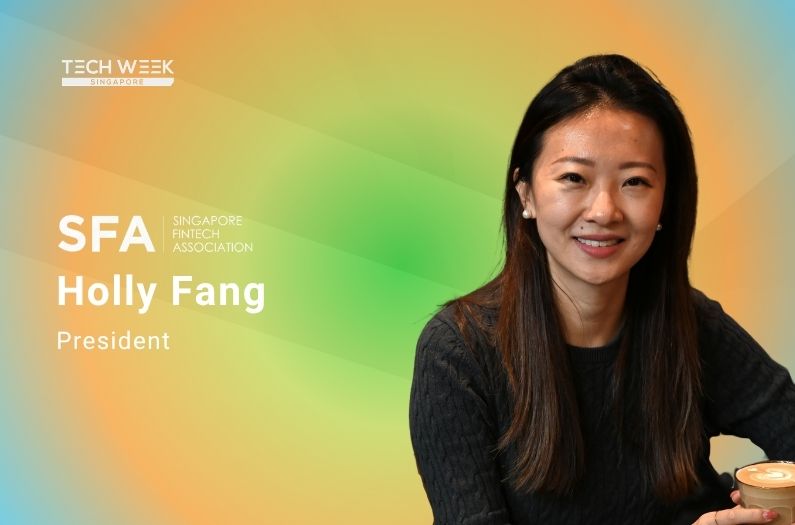
Holly Fang is President of the Singapore FinTech Association (SFA), Singapore’s leading national fintech industry body, where she represents the industry and works closely with regulators, financial institutions, technology companies and founders to advance the development of Singapore’s fintech ecosystem. In this role, she helps shape industry dialogue on innovation, regulation, talent and cross-border collaboration, while strengthening Singapore’s position as a leading global fintech hub.