PR and digital marketing for corporate clients as well as crisis communications.
1.When you look back at the start of your career, was there a defining moment that pushed you toward specializing in crisis communications and corporate PR?
There wasn’t a single defining moment, but working in politics in Washington, D.C. early in my career was formative. It’s one of the most intense environments for learning how to shape messages, manage stakeholders, and reach diverse audiences with one clear narrative.
Even further back, being the youngest of three boys forced me to develop quick debate skills and hold my own.
2. Corporate brands face very different challenges than consumer brands. How do you approach PR strategy for a corporate client?
When we talk about corporate versus consumer PR, we’re really talking about B2B versus B2C – and the dynamics are very different. With corporate clients, there’s often a deeper layer of politics involved. The economics are larger, the stakes are higher, and a single issue can create a significant downstream ripple effect, especially if a major supplier or partner is involved. There are also vested interests at the 30,000-foot level, long-standing agreements, partnerships, and relationships that can be put at risk if something isn’t managed carefully.
On the consumer side, the court of public opinion is much faster and far more unforgiving. Issues tend to unfold in real time, often on social media, which operates by its own rules. And there’s an old adage that “the people always get it right.” You may not agree with the reaction, but ultimately, the market decides.
3.With digital and social channels influencing brand perception in real time, how do you balance long-term strategy with fast-moving communication demands?
Speed and noise are the biggest factors today. Real-time response isn’t just expected, it’s demanded, so brands have to act quickly and decisively. At the same time, you can’t lose sight of the long view, and this is where the general noise level can actually help. There’s a predictable cycle where an issue feels catastrophic one day, and a few days later, the audience has moved on. In a chaotic environment, that can work to a brand’s advantage in managing the immediate moment.
But long-term trust can’t be rebuilt overnight; it comes from consistency over time. I often use the forest-fire analogy: first, you focus on putting out the fire, then you begin the process of replanting. The flames can be extinguished quickly, but the trees take much longer to grow back.
4.Crisis communications can make or break a company’s reputation. What is your core philosophy when helping organizations prepare for a crisis?
My core philosophy starts with understanding the big picture. You have to ground your approach in the broader reality, public trust in media, what’s dominating the news cycle, and the social trends influencing how people interpret information. Those external forces can either work against you or be used to your advantage.
I also emphasize taking inventory of the platforms and assets you already have. Do you have a large following, a passionate customer base, or even a high-profile adversary? Knowing what’s at your disposal helps shape the smartest next move.
Above all, people respond to authenticity. Many organizations go searching for the “right” answer in a crisis, but I always advise them to start with their answer, what they genuinely believe and know to be true. When you begin from that place, the path forward becomes clearer and more sustainable.
5.Can you share a time when a brand successfully turned a crisis into an opportunity, and what made that turnaround possible?
One example that stands out is the GameStop saga. At the height of the retail-investor frenzy, we were working with one of the world’s leading trading platforms (still a client). While our client wasn’t directly in crisis, the entire industry was under intense scrutiny. Instead of distancing ourselves, we leaned in, we engaged reporters, helped them make sense of what was happening, and provided clear, timely insight into the mechanics of the market.
That approach proved to be a major relationship builder. It established trust and credibility at a moment when the industry desperately needed clarity. As a result, the brand emerged stronger and soon became one of the most downloaded apps globally.
6.How do you foster alignment between PR, executive leadership, and legal teams during a crisis?
In a crisis, we’re almost always working directly with the C-suite and outside counsel, and alignment across those groups is essential. We operate with the belief that a bad day in court is worse than a bad day in the press, so we stay tightly synced with the legal strategy to ensure we do no harm.
That said, there’s more than one “court” deciding the outcome. The legal process can’t replace a thoughtful communications and reputation strategy. Our job is to balance both, protecting the legal position while making sure the brand responds appropriately in the public arena.
7.Do you think AI will have a role in crisis communications? If so, where should companies start experimenting responsibly?
AI is already playing a major role in crisis communications. On the threat side, AI-driven attacks are rising fast. Bad actors, especially in cyber, can now move quicker and operate more effectively, which makes a strong crisis-preparedness and infosec plan essential. Companies should be routinely pressure-testing their systems, and communications teams need to be integrated into that work.
On the response side, AI tools for understanding your brand, monitoring the market, and detecting early warning signals have advanced dramatically and should be leveraged.
And with the growth of LLM-based search, many people now discover and evaluate brands through AI systems. That has to be front and center in how companies think about their presence, both in normal times and especially after a crisis.
Robert Ford Bio:
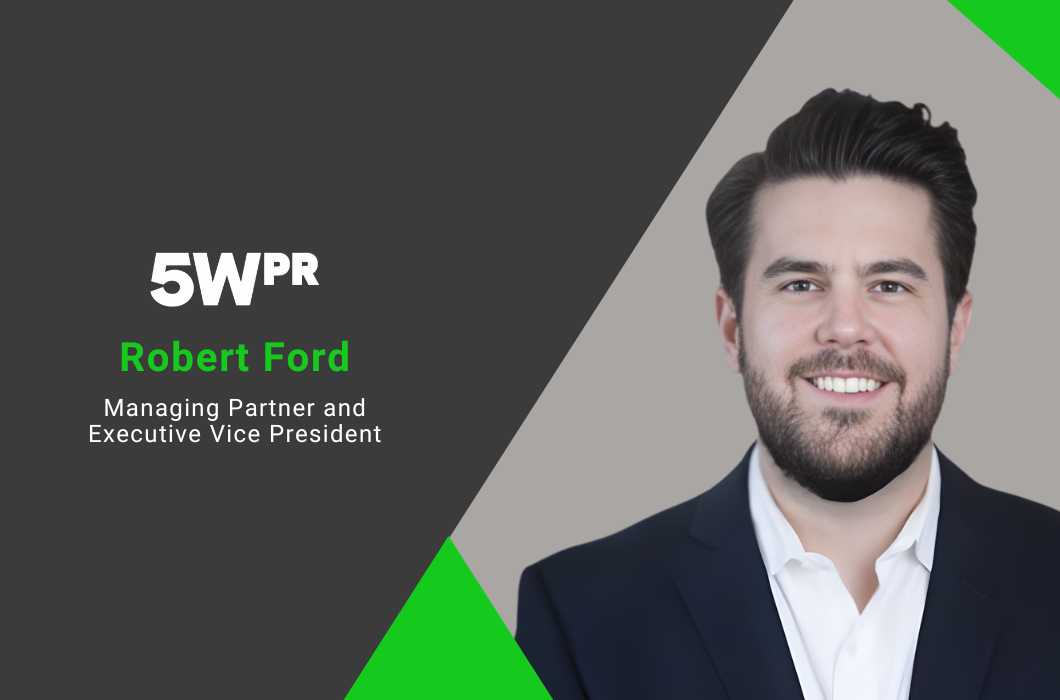
Rob Ford serves as Managing Partner and Executive Vice President, Corporate Communications division, and leads 5W’s Crisis Communications strategy across all agency divisions. He specializes in crisis strategy and brand protection for high growth and well-established companies and has led response around ransomware hacks, data breaches, government investigations, high-stakes litigation, complex transactions, and activist investor proxy fights involving major companies. He developed 5W’s crisis preparedness framework, advises c-suite leaders on crisis readiness and response, and media trains executives.
Rob’s team represents clients across a range of industries including real estate, financial services/fintech, enterprise technology, artificial intelligence, legal services, healthcare, and public affairs. He serves as the primary engine for strategic direction and campaign management and specializes in high-level media relations.
Company Bio:
5WPR is a full-service PR agency known for cutting-edge programs that engage with businesses, issues, and ideas. Founded in 2003, 5W has been named a top US and NYC PR Agency by leading industry publication O’Dwyer’s, as well as awarded Agency of the Year in the 2024 American Business Awards®, and continuously brings leading businesses a resourceful, bold, and results-driven approach to communication. The agency has more than 250 professionals serving clients in B2C (Beauty & Fashion, Consumer Brands, Entertainment, Food & Beverage, Health & Wellness, Travel & Hospitality, Technology, Nonprofit), B2B (Corporate Communications and Reputation Management), Public Affairs, Crisis Communications and Digital Marketing (Social Media, Influencer, Paid Media, SEO). In addition to its business accolades, 5W was named to the 2024 Digiday WorkLife Employer of the Year list. For more information and to join our team visit 5W Careers.