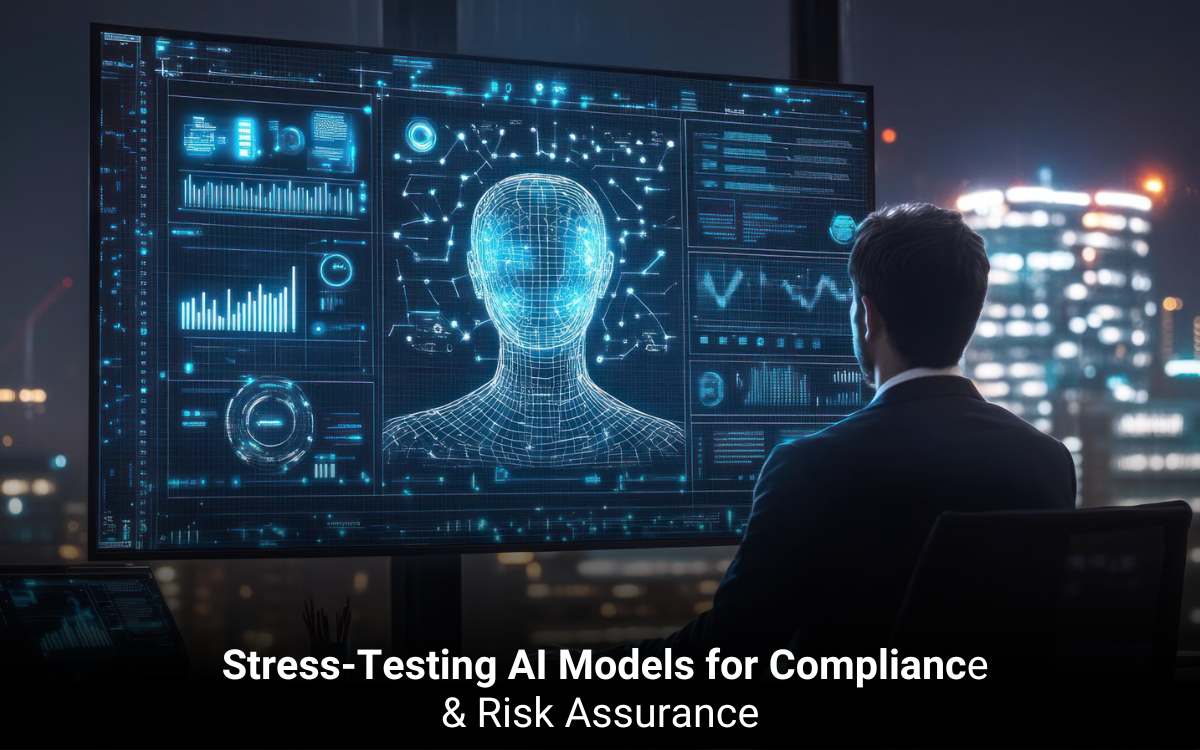
A global bank deploys an AI model to automate loan approvals. First, approvals are fast and operational costs are down. But soon, regulators flag bias in the model’s decisions, revealing that certain groups are denied loans. The model brings fines, reputational damage, and regulatory scrutiny. But if they had stress-tested AI models for compliance and risk, the situation could have been avoided.
Organizations are no longer judged only for their innovation but also by their ability to uphold transparency and fairness in decision-making. Stress-testing AI models is the equivalent of running a “crash test,” helping leaders understand how resilient they are to unexpected scenarios, and whether they comply with evolving regulations.
This article discusses the importance of stress testing AI models for compliance and risk.
How Stress-Testing Strengthens Responsible and Compliant AI Systems
Stress-testing strengthens responsible and compliant AI systems by exposing weaknesses and supporting regulatory expectations.
1. Simulating Real-world Threats Cases
Stress testing is more than functional testing. It involves testing AI models in extreme conditions, such as unusual data patterns, large-scale attacks, or partial input data. A FinTech company can test its AI models for handling large transaction volumes or complex attacks to ensure that the AI systems are accurate and do not compromise compliance.
2. Uncovering Hidden Bias and Fairness Issues
Stress testing can help in detecting biases that are hidden in extreme cases. For example, an AI-powered identity verification service may work well for most people but not for edge cases.
3. Protection from Attacks
Cybersecurity involves attackers searching AI systems for vulnerabilities. Adversarial testing of models with confusing or deceptive data helps organizations improve their defenses. A security company that stress tests its detection models will be less vulnerable to attacks based on predictable patterns.
4. Compliance with Regulations During High-Risk Situations
Regulatory bodies require AI systems to function within requirements even in high-risk situations. Stress testing is evidence that AI models function in predictable and transparent ways during high-risk situations.
5. Enhancing Human-in-the-Loop Controls
Stress testing is an assurance of AI model performance and human-in-the-loop procedure. It ensures that when AI confidence levels are low, human oversight is appropriate.
Scenario-Based Stress-Testing for AI Compliance and Risk Control
Scenario-based stress-testing turns AI compliance and risk control from theory into practice.
1. Creating Scenarios that reflect Real-world Risks
Realistic scenarios are essential for effective stress testing. These can range from coordinated cyber-attacks, unexpected traffic spikes, data corruption in regulations. For instance, a cybersecurity company can test the ability of AI models to separate noise from actual threats without flooding the security team with alerts by simulating a phishing attack.
2. Analyzing AI decision Boundaries
Scenario testing helps identify points where AI confidence falls or AI decisions become erratic. This is essential for risk management. A fintech company using AI for transaction monitoring can test scenarios that involve uncertain transactions to ensure proper escalation of alerts and initiation of human review at the correct point.
3. Compliance Validation in Extreme Scenarios
It is essential for AI systems to be compliant even during stress scenarios. Stress- testing helps in determining the ability of AI systems to make decisions that are explainable, auditable, and fair even during stress scenarios. A fintech platform can test its AI-based AML solutions during sudden spikes in transactions, ensuring that the compliance criteria are met.
4. Uncovering Bias and Edge-case Failures
Bias can be present in AI systems in extreme scenarios. Stress testing with unusual data sets can help in identifying such problems. An identity verification solution may work fine in regular scenarios but may not work well with unusual documentation formats or foreign users, which can be identified through stress- testing.
How to Integrate AI Stress-Testing into the Model Lifecycle
Integrating stress-testing into the AI model lifecycle ensures systems are resilient, compliant, and trustworthy.
1. Start Stress Testing from the Design Stage, and Not After Deployment
Organizations usually stress test their AI solutions only after they have been deployed. Stress testing should be conducted at the design stage of the AI solution, where assumptions can be modified. For example, a cybersecurity firm building an AI threat model should stress test traffic patterns at the design stage to ensure that the system is capable of handling actual attack.
2. Focus on High-Risk Scenarios Related to Business Use Cases
Effective stress testing should start with high-risk scenarios that are relevant to business use cases. In the area of cybersecurity, these could include simulated attacks, insider threats, or data poisoning attacks. A fintech firm could design scenarios around transaction traffic during peak hours to validate the correctness of fraud detection.
3. Integrate Stress Testing into Model Training and Validation
Stress tests should be integrated with the normal training and validation data. This will enable the models to learn how to deal with such situations right from the beginning. For instance, an endpoint security solution powered by AI can be trained on normal as well as attack behaviors.
4. Continuous Monitoring Post-Deployment
The behavior of AI changes over time. Stress testing needs to be done even after the deployment of AI models. An organization with a global presence can perform stress testing on its AI models on a quarterly basis to ensure that the models are effective against new threats.
Conclusion
Risk assurance addresses the strategic resilience of AI. AI Models exposed to stress-testing are better equipped to handle market shifts, data drifts, and emerging threats. It makes it a reliable tool for scaling operations and entering new markets. The organizations that will lead are those that recognize stress-testing as a continuous discipline. It will transform AI into an asset that drives sustainable growth and long-term trust. If your organization is scaling AI, now is the time to embed stress-testing into your governance framework.
Partner with compliance experts, invest in robust testing frameworks, and make stress-testing a pillar of your AI strategy. The future will belong to those who innovate responsibly and build resilience into every model they deploy.

Paramita Patra is a content writer and strategist with over five years of experience in crafting articles, social media, and thought leadership content. Before content, she spent five years across BFSI and marketing agencies, giving her a blend of industry knowledge and audience-centric storytelling.