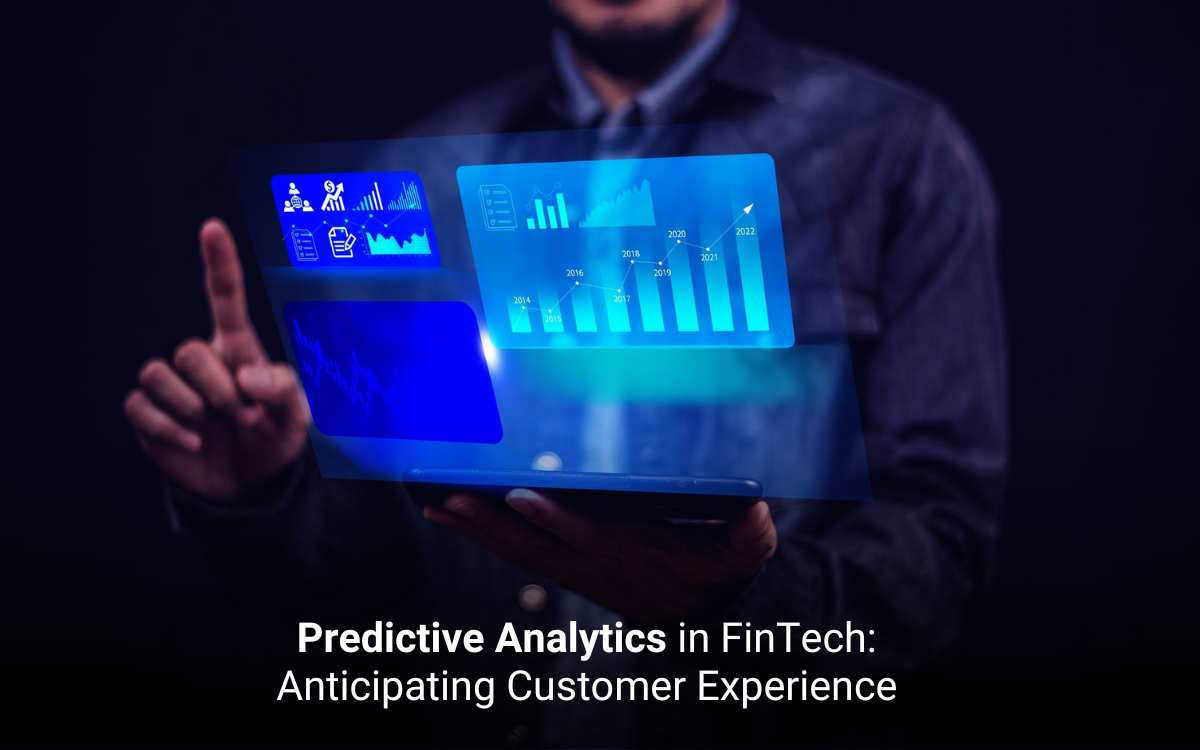
A customer opens his banking app on Monday morning, and the application warns him of a probable cash-flow dip next week, offering a short-term credit line tailored to his spending patterns. Later, the same customer gets a notification of unusual transaction behavior, preventing a potential fraud attempt. All the above is possible because of predictive analytics.
The new frontier of customer experience moves from service to intelligence. Financial technologies are redefining what “customer-centric” means. Today’s customers move toward those platforms that understand and predict intent, shaping long-term outcomes. Predictive Analytics has become the engine that empowers FinTech’s to become financial partners.
The article explains how predictive analytics improve customer experience in FinTech.
Why Predictive Analytics Has Become a Competitive Necessity
Below are some of the key reasons it has become a necessity for FinTech’s.
1. Retention Depends on Anticipating Behavior Before It Becomes Risk
Predictive churn models help FinTech’s identify the first signs of disengagement and enable timely interventions with targeted offers.
Example: A payment provider detects a decrease in the frequency of transactions coming from a logistics customer and reaches out to them with offers of price optimization and integration support.
2. Personalization Drives Revenue Growth
Predictive algorithms allow financial platforms to offer personalized journeys without additional operational costs.
Example: A corporate lending platform makes credit line recommendations based on historical cash flow patterns for SMEs.
3. Predictive Risk Intelligence Strengthens Compliance
Predictive models flag anomalies in real-time to limit exposure, thereby improving the Customer Experience by smoothly protecting them.
Example: Predictive anomaly detection on a cross-border remittance platform flags suspicious transfer patterns, enabling partners to stay compliant.
4. Speed of Decision-Making Defines Market Leadership
Predictive analytics compresses the decision cycle for faster, more intuitive Customer Experience.
Example: A supply chain financing company uses predictive credit scoring to approve vendor financing.
5. Predictive Capabilities Are Now a Market Expectation
Investors, partners, and buyers judge FinTech’s on their power to translate data into competitive intelligence.
Predictive Models Used in FinTech’s Customer Experience
Core predictive models driving this evolution include the following.
1. Predictive Churn Models
Segment customers who are likely to disengage or switch to a competitor. Provide interventions: for instance, personalized outreach, price optimization, or product upgrades.
Example: SaaS digital lending platforms use churn prediction to flag those clients who have lowered their API utilization, triggering the tailored engagement of the customer success team.
2. Next-Best-Action Models
Analyze customer behavior to recommend the most relevant action at any given moment through contextual interactions.
Example: The Corporate Banking Platform uses NBA modeling to suggest credit expansion opportunities to businesses experiencing seasonal spikes in demand.
3. Credit Risk and Behavioral Scoring Models
Forecast future creditworthiness based on real-time behavioral signals, and not just historical data. Reduce underwriting time while increasing accuracy.
Example: A finance provider employs behavioral scoring to assess vendors on invoice cycles, transaction velocity, and payment discipline.
4. Predictive Fraud Detection Models
Anticipate fraud based on the detection of anomalies, patterns, and behavioral biometrics.
Example: A cross-border remittance company deploys predictive fraud models to flag suspicious transfer flows for clients.
5. Customer Lifetime Value Prediction Models
Help FinTech’s identify segments and prioritize investments and enable more strategic resource allocation and personalized retention strategies.
Example: A commercial payments provider calculates CLV for clients to decide which accounts should get premium onboarding or dedicated support.
6. Product Upsell Models
Analyze usage patterns to predict which offerings will resonate most with business segments.
Example: A FinTech ERP integrator predicts which mid-size enterprises are most likely to adopt automated reconciliation modules based on prior transaction behaviors.
Benefits of Predictive Analytics to Customer Experience
The following are the benefits shaping competitive advantage in FinTech:
1. Low Friction Customer Support
Predictive models identify issues before they disrupt the customer’s journey so teams can intervene early.
Example: A digital payment provider employs predictive transaction monitoring to identify latency spikes for merchants and proactively alerts them before customers face checkout failures. This support reduces ticket escalations.
2. Intelligent Cross-Sell and Upsell Opportunities
Predictive models identify “micro-moments” when a customer is most likely to adopt additional products.
Example: A provider of treasury software can estimate when a customer will need hedging tools based on transaction flows and offer product suggestions.
3. Operational Efficiency and Faster Decision-Making
Automation of predictive insights reduces manual workload and thus enables teams to take their actions more quickly and accurately.
Example: An automated underwriting credit platform cuts underwriting time by automating risk scoring, enhancing both operational performance and the client experience.
4. Strategic Visibility to C-Suite Leaders
Predictive models provide leadership teams with insights that inform investment, product strategy, and resource allocation toward long-term Customer Experience over a short-term fix.
Conclusion
The way forward, therefore, is that the FinTech leaders who invest now set the trajectory for the next decade of customer experience innovation. Those who are not able to integrate predictive insights into operations run the risk of losing their customers to competitors who can anticipate needs. In an era marked by decisions and personalized engagement, one cannot afford to lag.

Paramita Patra is a content writer and strategist with over five years of experience in crafting articles, social media, and thought leadership content. Before content, she spent five years across BFSI and marketing agencies, giving her a blend of industry knowledge and audience-centric storytelling.