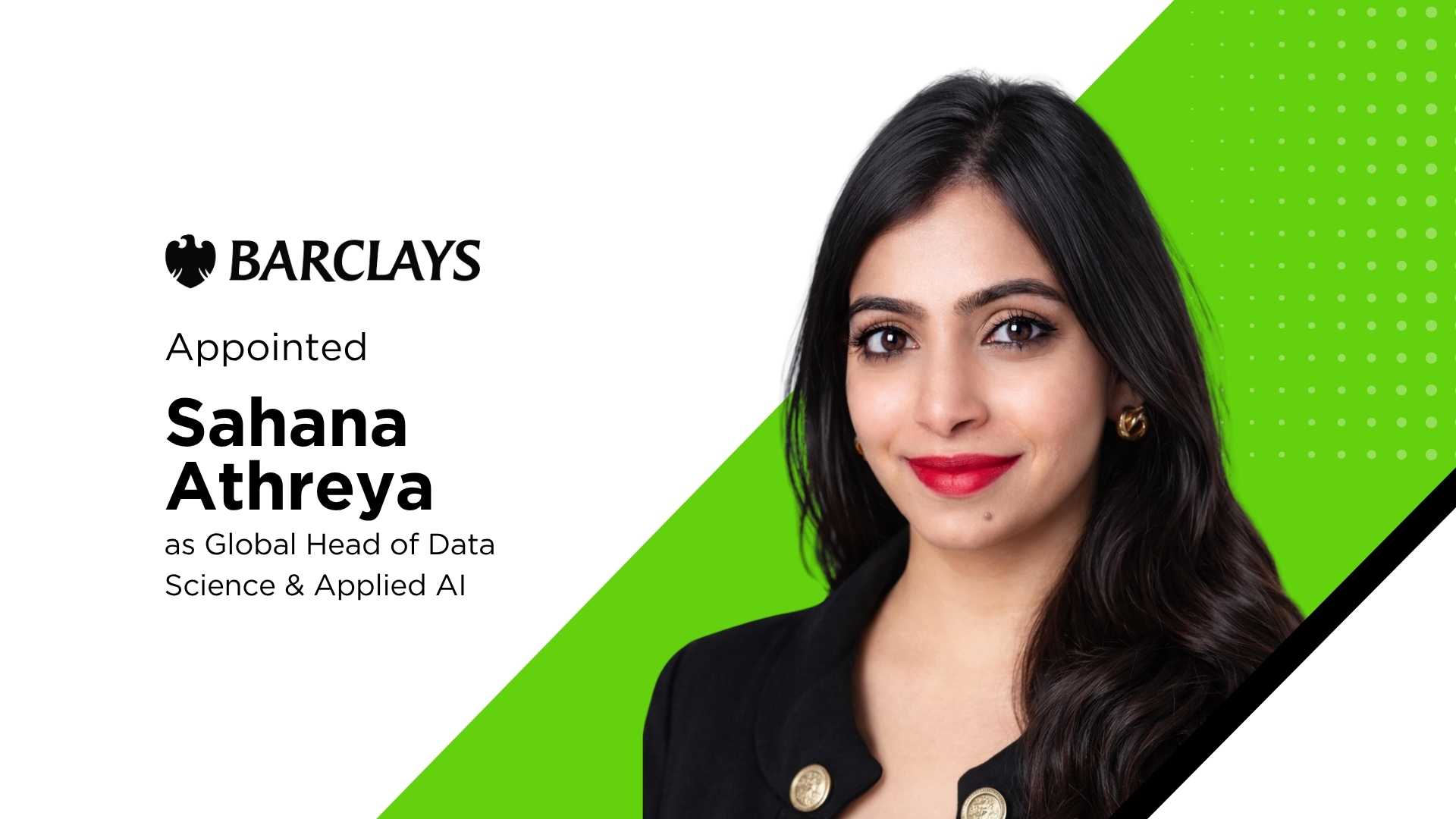
Barclays Research announced today that it has appointed Sahana Athreya as Global Head of Data Science & Applied AI, a move that signals the firm’s ambition to embed advanced analytics and artificial intelligence across its research platform and to meet the rising demand for data‑driven insights in the financial services sector.
Why the Appointment Matters
Athreya’s arrival marks the first time Barclays has created a dedicated global lead for both data science and applied AI within its research division. The role is designed to bridge the gap between traditional fundamental analysis and the burgeoning world of machine learning insight generation. By pairing quantitative expertise with deep market knowledge, Athreya is expected to accelerate the production of AI‑enhanced research reports, data products, and client‑facing tools that can be integrated into enterprise decision‑making pipelines.
The Role of AI in Modern Financial Research
Artificial intelligence is no longer a peripheral experiment in banking; it has become a core component of strategic forecasting, risk modeling, and client advisory. According to a recent Gartner forecast, AI‑enabled financial services solutions are set to generate $15 billion in incremental revenue by 2027, driven largely by faster data ingestion and predictive analytics. In practice, this means research analysts can augment their macro‑economic outlooks with real‑time sentiment analysis from alternative data sources—social media, satellite imagery, and transaction‑level feeds—while maintaining the rigor of traditional valuation models.
Athreya’s track record at hedge funds such as Eisler Capital and Millennium Management demonstrates her ability to translate raw data streams into actionable signals. At Barclays, she will oversee a team tasked with embedding alternative data pipelines, developing proprietary machine‑learning models, and delivering AI‑driven visualizations that can be embedded in client dashboards. The expected outcome is a more granular, faster, and scalable research offering that can be customized for institutional investors, corporate treasury departments, and fintech partners.
Industry Context and Competitive Landscape
Barclays is not the only legacy bank racing to institutionalize AI in research. Competitors like JPMorgan Chase, Goldman Sachs, and Citigroup have each launched internal AI labs or acquired fintech startups to bolster their analytical capabilities. However, many of these initiatives remain siloed, limiting cross‑functional adoption. Barclays’ decision to centralize data science under a single global head could give it a structural advantage, enabling consistent standards, reusable models, and faster time‑to‑insight across business units.
In the broader fintech ecosystem, platforms such as Snowflake, AWS, and Microsoft Azure are providing the cloud infrastructure that makes large‑scale model training feasible. Meanwhile, open‑banking APIs and embedded finance solutions are feeding richer data streams into the analytical engine. By aligning its AI roadmap with these infrastructure trends, Barclays positions itself to compete not just with other banks but also with pure‑play data‑analytics firms like Bloomberg Intelligence and Refinitiv, which already offer AI‑enhanced research as a service.
Implications for Enterprise Marketing Teams
For corporate marketers, the ripple effects are immediate. AI‑enhanced research can feed more precise audience segmentation, predictive spend modeling, and performance attribution. marketing platforms that integrate with Barclays’ data products will be able to pull real‑time financial sentiment, macro‑economic risk indicators, and sector‑specific forecasts directly into campaign planning dashboards. This level of granularity supports more agile budget allocation and can improve ROI measurement by linking spend to macro‑economic outcomes.
Moreover, the new research outputs are expected to be packaged as APIs and data feeds, allowing marketing platforms—such as Salesforce Marketing Cloud or Adobe Experience Platform—to ingest them without custom engineering. The result is a tighter feedback loop between market intelligence and customer engagement, a capability that many B2B marketers consider a competitive differentiator.
Looking Ahead: From Proof‑of‑Concept to Enterprise Standard
Athreya’s mandate includes scaling pilot projects into production‑grade services. Early initiatives will likely focus on natural‑language processing of earnings calls, anomaly detection in transaction data, and predictive modeling of credit spreads. As these models mature, Barclays plans to expose them through a marketplace of AI‑powered research tools, enabling clients to license specific modules rather than the entire suite.
If successful, this approach could redefine how financial research is monetized, shifting from a static report model to a subscription‑based, on‑demand analytics platform. It also aligns with the broader trend of embedded finance, where non‑financial firms embed banking services directly into their customer experiences. By offering AI‑driven insights as a plug‑in, Barclays could become a preferred data partner for fintech startups building credit‑scoring engines, payment routing solutions, or wealth‑management apps.
Market Landscape
The convergence of digital payments, open‑banking infrastructure, and blockchain‑based settlement is accelerating the flow of granular financial data. IDC predicts that worldwide spending on AI‑augmented fintech solutions will surpass $30 billion by 2026, driven largely by banks seeking to improve operational efficiency and client engagement. In this environment, data science leadership becomes a strategic asset, enabling institutions to turn raw data into competitive intelligence faster than rivals. Barclays’ appointment of Athreya reflects a broader industry shift: moving AI from experimental labs into the core of research, risk, and client‑facing services.
Top Insights
- Strategic Consolidation: Centralizing data science under a global head gives Barclays a unified AI roadmap, reducing siloed development and speeding time‑to‑market.
- Competitive Edge: By delivering AI‑enhanced research as modular APIs, Barclays can compete with both traditional banks and pure‑play analytics firms for fintech partnerships.
- Marketing Synergy: Enterprise marketers can integrate real‑time financial sentiment and macro forecasts into campaign planning, improving budget efficiency and ROI attribution.
- Industry Momentum: Gartner forecasts AI‑driven financial services revenue to add $15 billion by 2027, underscoring the commercial urgency of the move.
- Future‑Proofing: Embedding AI across research paves the way for a subscription‑based analytics marketplace, aligning with the embedded finance trend.
Get in touch with our fintech expert