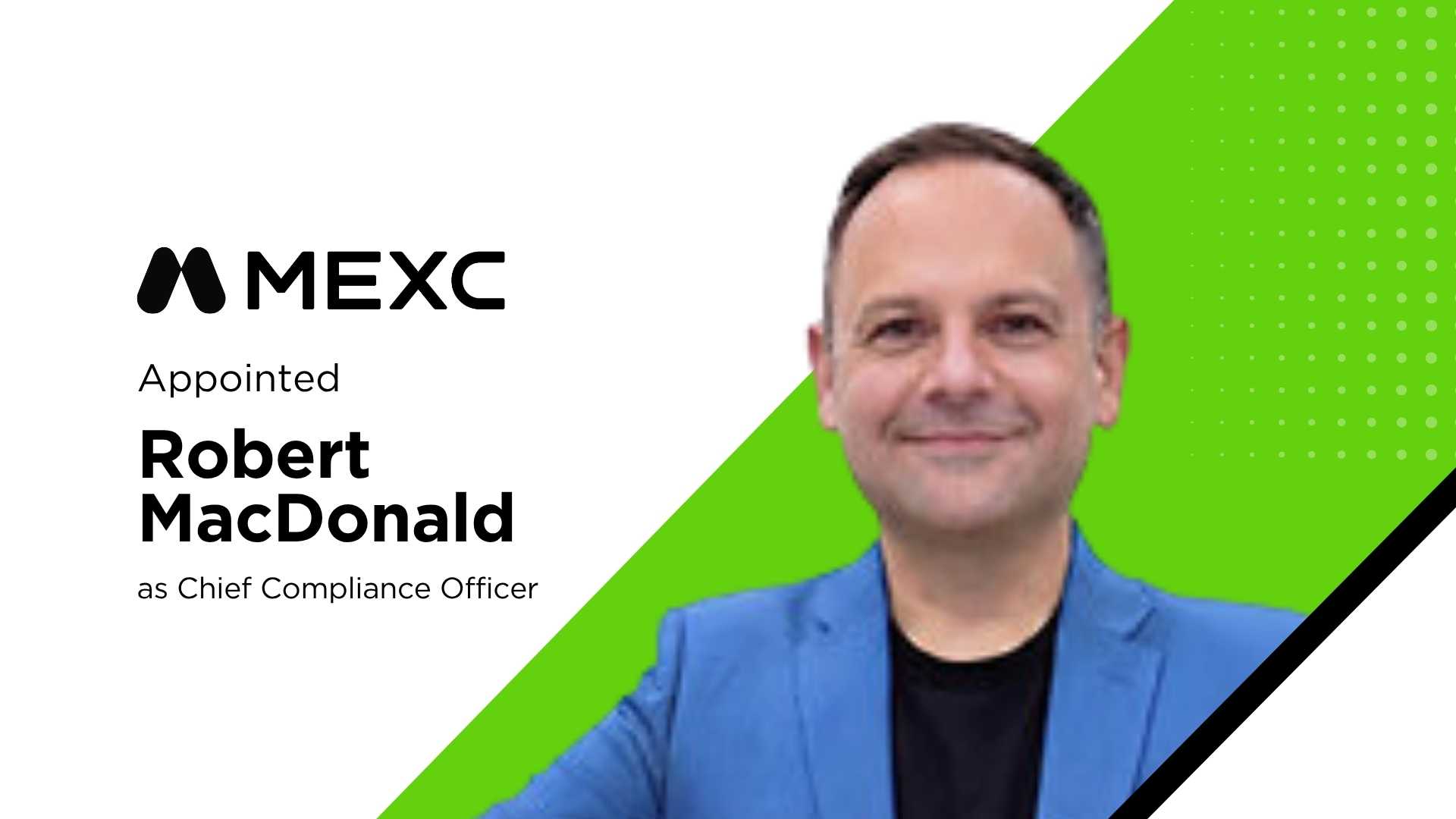
As cryptocurrency exchanges navigate increasingly complex regulatory requirements worldwide, MEXC has appointed veteran compliance executive Robert MacDonald as its new Chief Compliance Officer (CCO). The leadership move comes as the digital asset platform expands beyond cryptocurrency trading into broader financial products, signaling a stronger focus on governance, regulatory engagement, and enterprise-grade compliance infrastructure.
The race to build compliant digital asset platforms is intensifying as regulators across major financial markets introduce stricter oversight of cryptocurrency businesses. Against this backdrop, MEXC has named Robert MacDonald as its Chief Compliance Officer, bringing more than two decades of experience across traditional banking, fintech, and digital assets to lead the exchange’s global compliance strategy.
MacDonald joins MEXC after serving as Chief Legal and Compliance Officer at Bybit, where he oversaw global licensing initiatives, legal operations, and the implementation of anti-money laundering (AML) and know-your-customer (KYC) frameworks across multiple jurisdictions. Earlier in his career, he held senior regulatory and compliance leadership roles at Standard Chartered and Binance, focusing on governance transformation and regulatory strategy.
The appointment reflects a broader shift across the cryptocurrency industry, where regulatory readiness is becoming as important as product innovation. Exchanges are increasingly investing in compliance leadership to meet evolving licensing requirements and strengthen relationships with financial regulators worldwide.
MEXC said MacDonald will oversee its global compliance framework, corporate governance, and regulatory engagement strategy as the company expands its financial services portfolio. His responsibilities will focus on developing scalable governance models that align with international regulatory standards while adapting to local compliance requirements across multiple markets.
The company has recently broadened its platform beyond cryptocurrency trading, introducing access to additional financial products, including equities-related offerings, IPO opportunities, and other investment products. That expansion places MEXC among a growing number of digital asset firms seeking to evolve into multi-asset financial platforms that combine traditional and digital investment opportunities.
As exchanges diversify their offerings, compliance requirements also become more complex. Managing multiple asset classes often requires adherence to different regulatory frameworks governing securities, payments, digital assets, consumer protection, and financial crime prevention.
MacDonald’s mandate centers on three strategic priorities designed to address those challenges.
The first involves strengthening cross-jurisdictional governance by building compliance systems capable of meeting international standards while accommodating local regulatory requirements. This has become increasingly important as jurisdictions such as the European Union, Singapore, Hong Kong, and the United Arab Emirates introduce comprehensive licensing regimes for virtual asset service providers.
The second priority focuses on data-driven risk management. MEXC plans to expand the use of analytics and automated compliance infrastructure to monitor operational risks, detect suspicious activity, and improve oversight across its expanding product ecosystem. Advanced compliance technologies, including artificial intelligence and machine learning, are becoming increasingly common across financial institutions seeking to automate transaction monitoring and fraud detection.
The third pillar emphasizes proactive engagement with regulators and industry organizations. Rather than responding solely to regulatory changes, many digital asset firms are participating in policy discussions to help shape emerging standards for market integrity, investor protection, and operational resilience.
MacDonald’s appointment also reflects changing market expectations around trust and governance within digital finance. Institutional investors, payment providers, and banking partners increasingly evaluate exchanges based not only on trading volume and liquidity but also on governance standards, cybersecurity controls, and regulatory transparency.
Industry analysts have noted that compliance leadership has become a strategic differentiator as digital asset markets mature. According to PwC’s Global Crypto Regulation Report, jurisdictions worldwide continue accelerating the implementation of comprehensive regulatory frameworks, while Chainalysis reports that institutional participation in digital assets has continued growing alongside greater regulatory clarity.
Research from Boston Consulting Group (BCG) estimates that the tokenized asset market could reach trillions of dollars by the end of the decade, provided market infrastructure, custody, and regulatory frameworks continue to mature. That outlook has encouraged exchanges to strengthen operational controls before expanding into broader financial services.
For enterprise partners, financial institutions, and regulators, leadership appointments such as this indicate that cryptocurrency exchanges are increasingly aligning their governance structures with practices common across traditional financial services.
MEXC’s investment in compliance infrastructure also follows a wider industry trend. Competitors including Coinbase, Kraken, OKX, and Binance have all expanded legal, compliance, and regulatory affairs teams over the past several years as governments introduce new digital asset legislation.
While product innovation remains central to competition among exchanges, governance is becoming equally important for long-term growth. As digital assets move closer to mainstream financial markets, platforms capable of balancing innovation with regulatory accountability are likely to be better positioned to attract institutional capital, expand internationally, and introduce regulated financial products.
MacDonald’s appointment signals that MEXC views compliance not simply as a regulatory obligation but as a foundational capability supporting its broader ambitions in global digital finance.
Market Landscape
The cryptocurrency industry is entering a new phase in which regulatory compliance is becoming a core competitive advantage. Frameworks such as the European Union’s Markets in Crypto-Assets (MiCA) regulation and evolving licensing regimes across Asia-Pacific and the Middle East are encouraging exchanges to strengthen governance, AML controls, and risk management. As digital asset platforms diversify into tokenized assets, equities, and investment products, enterprise-grade compliance infrastructure is becoming essential for sustainable international expansion and institutional adoption.
Top Insights
- MEXC has appointed former Bybit executive Robert MacDonald as Chief Compliance Officer to lead global governance, regulatory engagement, and compliance transformation as the exchange expands internationally.
- The appointment reflects an industry-wide shift toward stronger regulatory infrastructure as cryptocurrency exchanges diversify into multi-asset investment platforms beyond traditional digital asset trading.
- MEXC plans to strengthen cross-border governance, deploy data-driven compliance technologies, and deepen engagement with regulators to support scalable and responsible platform growth.
- Enterprise-grade AML, KYC, and automated risk management capabilities are becoming increasingly important as exchanges seek institutional partnerships and regulatory approvals across multiple jurisdictions.
- The move aligns with broader market trends where governance, operational resilience, and regulatory trust are emerging as critical differentiators in digital finance.
Get in touch with our fintech expert