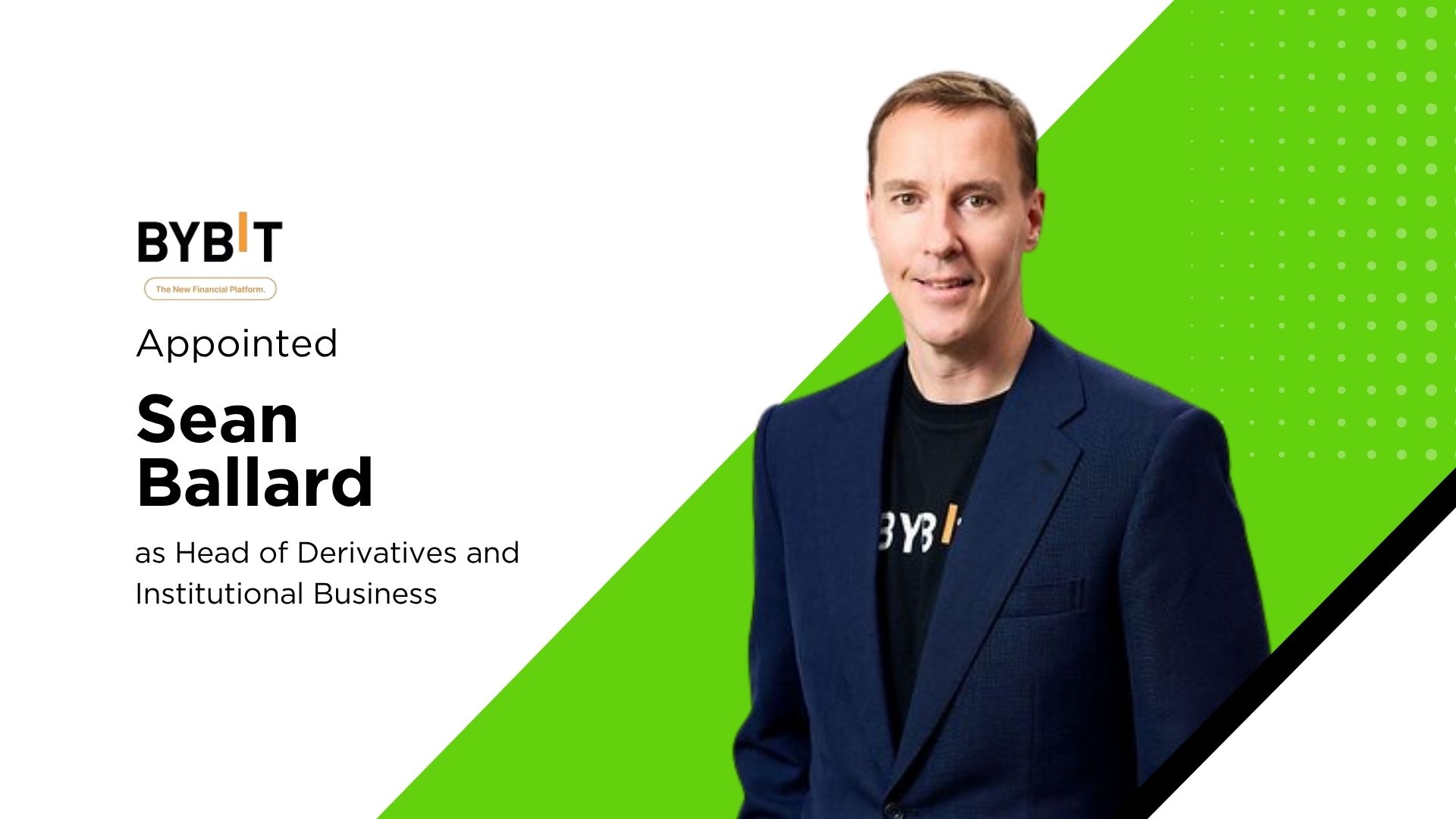
Crypto exchanges are increasingly competing on the infrastructure that sits behind trading, not just on the number of tokens or contracts they list. Bybit is reinforcing that institutional push by appointing Sean Ballard, a veteran of derivatives and high-frequency trading, as its new Head of Derivatives and Institutional Business. The move comes as crypto trading becomes more closely integrated with traditional financial markets and institutional investors place greater emphasis on execution, risk controls, custody and market structure.
The institutional crypto market is entering a phase where trading infrastructure may matter as much as trading access.
Exchanges are competing for professional traders and institutions through faster execution, stronger risk management, sophisticated derivatives products and connections to traditional financial infrastructure. Bybit’s latest executive appointment reflects that shift.
The exchange has named Sean Ballard as Head of Derivatives and Institutional Business, giving him responsibility across derivatives, institutional trading, trading risk and exchange technology. Bybit announced the appointment on September 2.
Ballard brings more than 25 years of experience across global financial markets. He joins Bybit from Jump Trading, where he led the firm’s high-frequency futures trading business across the U.S., Europe, the Middle East and Africa, and Latin America. His background spans derivatives, market structure, high-frequency trading, risk and exchange infrastructure.
He also worked within Jump Crypto on trading initiatives involving centralized crypto exchanges and strategic partnerships.
That combination of traditional-market and crypto experience is significant because the architecture of institutional digital-asset trading increasingly resembles that of established financial markets.
Institutional participants care about latency and liquidity, but they also care about collateral, custody, counterparty exposure, settlement, market access and operational resilience.
The broader market is moving in that direction. A June 2026 paper from the International Swaps and Derivatives Association (ISDA) argued that institutional participation in digital-asset derivatives increasingly depends on how exposures are structured, margined and settled, as well as how collateral and operational risks are managed.
Bybit’s own institutional strategy is increasingly built around those requirements.
The exchange says its institutional business has added services including bank triparty arrangements, which are designed to allow institutions to retain trading access while managing counterparty exposure through regulated custody arrangements. It has also introduced a Market Maker Gateway, which Bybit says reduced round-trip latency for high-frequency and quantitative clients from 4 milliseconds to 1.5 milliseconds.
For market makers, a reduction of that magnitude can be meaningful. In highly automated markets, milliseconds can affect execution quality, arbitrage opportunities and the ability to manage positions across venues.
But speed alone is no longer enough.
Crypto derivatives remain a highly concentrated and volatile market. CoinGlass estimates that global crypto derivatives volume reached $35.08 trillion in the first half of 2026, down 15.7% from the same period a year earlier. Average daily open interest fell by a smaller 10%, to $112.7 billion, suggesting that outstanding exposure remained relatively resilient even as trading turnover declined.
The market structure also shows a growing divide between crypto-native exchanges and traditional financial venues.
CoinGlass reported that the top 10 exchanges accounted for 81.2% of derivatives volume during the first half of the year. CME, meanwhile, represented a much larger share of open interest than trading volume, a pattern consistent with a participant base that includes institutional hedging and longer-duration positions.
That creates a competitive opening for exchanges such as Bybit.
Rather than compete solely for retail trading activity, crypto venues are attempting to build the infrastructure required by hedge funds, proprietary trading firms, asset managers and professional market makers.
The appointment of a former high-frequency trading executive suggests Bybit wants to make that infrastructure a central part of its product strategy.
There is another important development behind the move: the convergence of crypto trading with traditional financial markets.
In September, Standard Chartered launched institutional spot cryptocurrency trading in the United Arab Emirates, becoming the first globally systemically important bank to offer such services in the Gulf market, according to Reuters.
Meanwhile, the London Stock Exchange is preparing a tokenized-equity initiative with Kraken parent Payward, with plans for tokenized versions of major UK equities and a digital trading venue.
These developments point toward a financial system in which crypto exchanges, banks, custodians, traditional exchanges and blockchain infrastructure increasingly overlap.
Bybit is also pursuing that convergence through tokenized real-world assets.
Its Bybit RWA Earn offering includes tokenized financial products, and the company says FUIDL by Finloop, an AAA-rated U.S.-dollar money-market fund, has been available on the exchange as trading collateral since July 2026.
The strategy broadens the role of an exchange. Instead of being simply a venue for buying and selling cryptocurrencies, Bybit is positioning itself as a financial infrastructure provider spanning crypto derivatives, institutional execution, custody arrangements and tokenized traditional assets.
That puts it into a competitive field that includes CME Group, Coinbase, OKX, Binance, Kraken and other venues targeting professional digital-asset traders.
The differences between these platforms increasingly come down to market structure and institutional plumbing.
CME provides a regulated derivatives venue with deep institutional participation. Crypto-native exchanges can offer broader product ranges and, in some jurisdictions, more flexible trading structures. Custodians and prime brokers are meanwhile building services that separate asset custody from execution, addressing a key concern for institutional investors.
Bybit’s challenge is to make all of those components work together while maintaining robust risk controls.
That matters because institutional investors are becoming more demanding. A 2026 survey from Coinbase and EY-Parthenon of 351 institutional decision-makers found that 49% had strengthened their focus on risk management, liquidity and position sizing. Nearly three-quarters said they planned to increase crypto allocations, while 81% preferred gaining spot exposure through registered vehicles.
The message for exchanges is clear: institutional demand does not automatically translate into institutional trust.
Ballard’s remit therefore extends beyond derivatives product development. His role covers the underlying trading technology and risk architecture needed to support larger and more sophisticated participants.
For Bybit, the appointment is ultimately a bet on infrastructure.
As crypto markets become more intertwined with traditional finance, the competitive advantage may increasingly belong to platforms that can deliver institutional-grade execution, collateral management, custody connectivity and risk controls—not simply high trading volumes.
Market Landscape
The crypto derivatives market is entering a more institutional phase, but that transition is not occurring uniformly.
CoinGlass estimates $35.08 trillion in crypto derivatives volume during H1 2026, while open interest remained comparatively resilient at an average $112.7 billion per day.
At the same time, traditional financial infrastructure is moving toward digital assets. Cboe says derivatives have become the primary venue for crypto price discovery and risk transfer, while tokenization is creating additional connections between blockchain networks and established capital markets.
The result is a competitive landscape spanning:
- Crypto-native exchanges: Bybit, Binance, OKX and others.
- Regulated derivatives venues: CME Group and emerging regulated platforms.
- Institutional crypto brokers and custodians: Companies building execution, custody and prime-services infrastructure.
- Traditional banks: Increasingly offering digital-asset trading and custody.
- Tokenization platforms: Connecting blockchain infrastructure with bonds, funds, equities and other traditional assets.
For institutional trading teams, the critical criteria are increasingly liquidity, latency, collateral, custody, risk management, regulatory access and operational resilience.
Top Insights
- Bybit appointed former Jump Trading executive Sean Ballard to lead derivatives and institutional business as competition shifts toward sophisticated trading infrastructure.
- Ballard’s background spans high-frequency futures, crypto trading, market structure and exchange technology, aligning with Bybit’s focus on professional trading clients.
- Bybit says its Market Maker Gateway reduced round-trip latency from 4 milliseconds to 1.5 milliseconds for high-frequency and quantitative trading clients.
- Institutional investors are demanding stronger risk management, liquidity and regulated access as crypto increasingly converges with traditional financial markets.
- Bybit’s expansion into tokenized real-world assets and institutional services signals an effort to become broader financial infrastructure rather than simply a cryptocurrency exchange.
Get in touch with our fintech expert