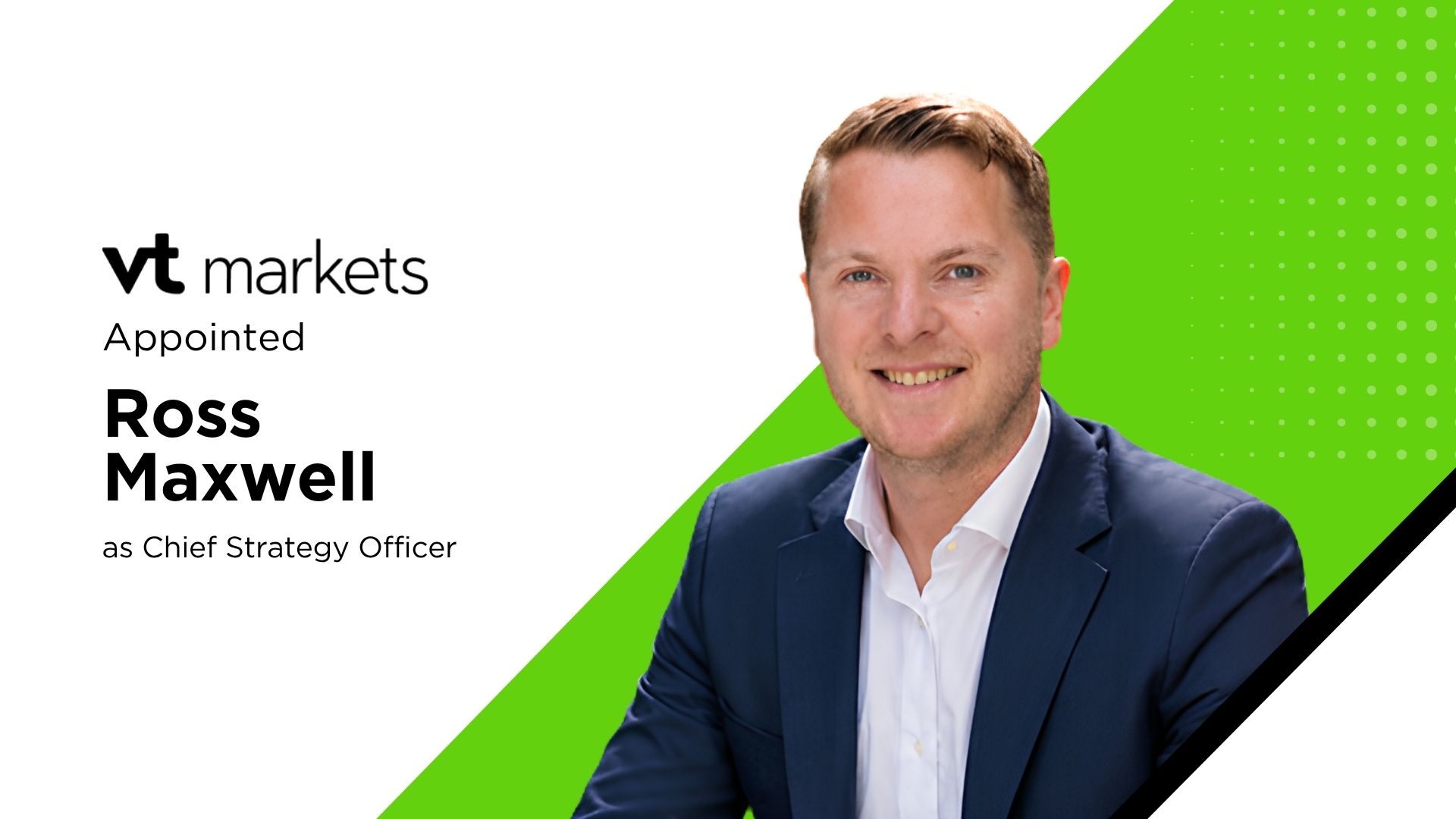
Online trading platforms are increasingly competing on more than the number of markets they offer. The next battleground is how quickly traders can move between asset classes, interpret market information and manage risk from a single digital environment. VT Markets is responding to that shift with the appointment of Ross Maxwell as Chief Strategy Officer, giving him responsibility for platform development, international growth, governance and the company’s push toward a more integrated multi-asset trading ecosystem.
The appointment of Ross Maxwell as Chief Strategy Officer marks a strategic step for VT Markets as the broker attempts to position itself beyond traditional trade execution.
Maxwell, who previously served as the company’s Global Strategy & Operations Lead, will oversee long-term strategy spanning platform innovation, global expansion and corporate governance. His remit also includes responsible-trading initiatives and the development of AI-driven financial-literacy programs for retail traders.
The move comes as brokers face a changing competitive environment.
Foreign exchange remains a core part of online trading, but retail platforms increasingly offer combinations of equities, indices, commodities, cryptocurrencies and other financial instruments. For users, the appeal is straightforward: fewer platforms, a unified account experience and access to multiple markets as macroeconomic conditions shift.
For brokers, however, building that experience is considerably harder than simply adding another asset class.
A genuine multi-asset platform needs a technology architecture capable of handling different instruments, pricing models, liquidity sources, risk controls and market schedules. It also has to present that complexity without overwhelming users.
That is where VT Markets says Maxwell’s role will extend beyond conventional corporate strategy.
The company describes its direction as a tech-led ecosystem connecting digital assets with traditional financial markets. The strategy also emphasizes market intelligence and education, suggesting that the platform is being designed not only around execution but around the decision-making process that comes before a trade.
That distinction matters as retail participation in complex financial products grows.
Regulators have increasingly focused on whether investors understand the products they are trading and whether platforms provide adequate information about costs and risks. The UK’s Financial Conduct Authority, for example, continues to impose specific protections around contracts for difference, including leverage restrictions and standardized risk warnings.
The FCA’s 2026 review of AI in retail financial services adds another dimension. The regulator says AI could transform consumer journeys and financial decision-making while also amplifying fraud, cybersecurity and market-concentration risks. Its research found that around one in five UK adults—about 11 million people—could be likely to use AI capable of acting autonomously within preset goals.
That creates an interesting opportunity—and challenge—for brokers.
AI can potentially help translate market information into more accessible explanations, identify relevant educational material or personalize learning pathways. But an AI system that moves from explaining a market to influencing or executing a trade raises much more significant questions around suitability, transparency and accountability.
VT Markets says Maxwell will champion AI-driven financial literacy rather than simply using AI as another trading feature.
That could become an important distinction.
Retail trading platforms have spent years reducing friction between discovering an opportunity and placing an order. The industry is now confronting the possibility that too much friction reduction can also reduce the time investors spend understanding what they are doing.
Education therefore becomes part of platform design.
VT Markets’ existing Insights operation illustrates the direction. The company publishes market analysis covering forex, gold, oil, equities and crypto, with recent commentary spanning macroeconomic developments and cross-asset market moves.
The broader platform strategy appears designed to connect that type of information with execution.
Instead of treating research, education and trading as separate products, brokers can increasingly integrate them into one workflow: identify a market event, understand its potential impact, compare asset classes, assess risk and then decide whether to trade.
The technology challenge is building that workflow without creating the impression that analysis constitutes a recommendation or that automation eliminates investment risk.
This becomes especially important when digital assets are added to the same environment as traditional markets.
Crypto trades around the clock, while many traditional markets operate within defined sessions. Liquidity, volatility and market structure also differ significantly between asset classes. A unified interface can make those differences less visible to inexperienced users even as the underlying risks remain.
For institutional traders, meanwhile, the priorities are somewhat different.
Execution quality, liquidity, infrastructure resilience, analytics, risk controls and operational scalability tend to matter more than educational content. VT Markets says Maxwell will also work on expanding institutional-grade multi-asset capabilities, suggesting the company is targeting both sides of the platform market.
That places the firm in a crowded field.
Global brokers and trading-technology providers are competing to combine multiple asset classes with sophisticated charting, research, automated strategies and increasingly AI-assisted tools. Large ecosystems such as Interactive Brokers have already built multi-asset access into their core propositions, while specialist platforms compete through user experience, pricing, social features or specific asset classes.
The competitive question is therefore no longer simply whether a broker offers forex, stocks or crypto.
It is whether those markets feel like parts of one coherent financial operating environment.
That shift also changes what a chief strategy officer needs to manage.
Platform architecture, market expansion, regulatory expectations, education, institutional services and customer experience increasingly overlap. A product decision can have compliance implications. A new asset class can change liquidity and risk requirements. An AI feature can alter how customers make financial decisions.
Maxwell’s background across macroeconomic analytics, operations and market infrastructure is consequently relevant to the role.
Still, the strategy will have to balance growth with responsible trading.
IOSCO has highlighted the risks created by increasingly complex products and leverage for retail investors, while regulators globally continue to examine how digital engagement affects investor behavior.
For VT Markets, the challenge is to make a broader range of financial markets easier to access without making their risks easier to overlook.
The company’s strategy under Maxwell appears to recognize that distinction.
The next generation of trading platforms may indeed be unified, AI-assisted and multi-asset. But the strongest platforms are likely to be judged not only by how quickly they execute trades, but by how effectively they help users understand the markets they are entering.
Market Landscape
The online brokerage market is moving toward multi-asset access, integrated market intelligence and AI-assisted financial experiences.
Several trends are shaping the sector:
- Multi-asset convergence: Brokers are combining forex, equities, indices, commodities and digital assets within unified platforms.
- AI-assisted trading experiences: AI is increasingly being used for research, education, personalization, analytics and workflow automation.
- Retail investor protection: Regulators are paying closer attention to leverage, product complexity, disclosures and digital engagement.
- Institutional-grade infrastructure: Brokers are investing in execution, liquidity, analytics and operational technology to attract professional clients.
- Financial literacy: Education is becoming a platform feature as investors gain access to increasingly complex products.
The FCA’s 2026 AI review describes AI as a potentially defining force in retail financial services while highlighting risks around consumer harm, fraud, cybersecurity and market concentration.
That makes responsible AI deployment a competitive issue as much as a regulatory one.
Top Insights
- Ross Maxwell will lead VT Markets’ strategy across platform development, global expansion, governance and responsible multi-asset trading.
- VT Markets is positioning its platform around connections between traditional financial markets and digital assets rather than isolated trading products.
- AI-driven financial literacy will become part of the company’s strategy as regulators scrutinize automated consumer experiences.
- The broker is also targeting institutional-grade capabilities, increasing the importance of infrastructure, liquidity and execution technology.
- Multi-asset platforms must balance convenience and personalization with clear communication of leverage, complexity and market risk.
Get in touch with our fintech expert